Online Music theory Course
More Links
- Accordion
- Cajon
- Cello
- Clarinet
- Classic Violin
- Double Bass
- Electric Guitar
- Flute
- Guitar
- Handpan
- Hangderam
- Harmonica
- Harmonica
- Harp
- Lakota Fluet
- Lyre
- Melodica
- Persian Tang
- Piano
- Saxophone
- Ukulele
- Violin Alto
- Hearing training
- Iranian Singing
- Persian Avaz
- Persian Chore
- Persian Foley
- Persian Pop Singing
- Persian Singing
remove filters


Aryana Shirangi - Music theory
Tuition : 1,200,000 toman
Mehran Ghasemi - Music theory
Tuition : 2,000,000 toman
Abouzar Esmaeili - Music theory
Tuition : call for priceStudents Videos

Music theory
Online Music Theory Lessons – Finally Make Sense of the Music You Play
You can play songs without knowing much music theory. But sooner or later, you may find yourself asking questions like: Why does this chord work here? Why does this melody sound right? What key am I actually playing in?When these things aren't clear, learning a new song, composing, improvising, or even talking about music can become much harder than it needs to be.
Our online music theory lessons help you understand what's happening behind the music you're already playing — without turning every lesson into a list of complicated rules to memorize.
Music Theory Without the Confusing Jargon
A good music theory course should help you understand music, not make you feel like you're studying a completely different subject.You'll gradually learn how notes, scales, chords, melody, harmony, and rhythm fit together. Instead of learning isolated definitions, you'll see how each concept appears in actual music.
The goal is simple: when you play something, you should have a better idea of why it sounds the way it does.
From Notes and Scales to Real Music
Music starts with individual notes, but those notes don't exist on their own.You'll explore musical scales, including major and minor scales, and learn how they create different musical colors and provide the foundation for melodies and chords.
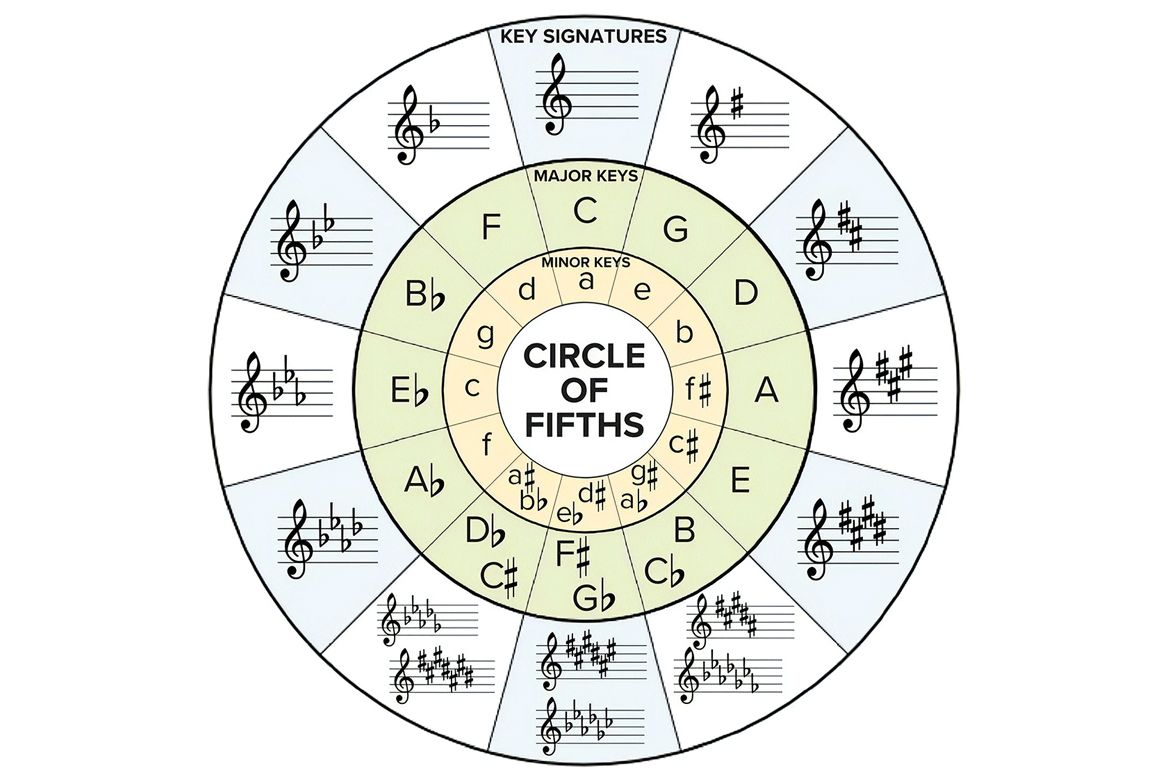
You'll also learn how key signatures help you understand which notes belong naturally to a particular key, making written music much easier to read and understand.
Intervals, Chords and Harmony – See How Everything Connects
Once you understand the relationship between notes, more of the musical picture starts to come together.You'll learn about intervals and how the distance between notes affects the way they sound. From there, you'll explore chords and how different chords can support a melody.
Then comes harmony — the bigger picture of how notes and chords interact.
Instead of memorizing chord names without understanding them, you'll start seeing the connections between scales, chords, and the music you actually hear.
Melody and Rhythm: The Parts You Already Use
You don't need to be a composer to benefit from understanding melody and rhythm.You'll learn how melodies are built, how rhythmic patterns organize music, and how these elements work together to create a musical phrase.
This can be especially useful when learning songs, writing your own music, improvising, or trying to understand why a particular section feels different from another.
What Can You Expect to Improve?
With regular study and practice, you can develop:A clearer understanding of music theory
Better knowledge of major and minor scales
A stronger understanding of intervals and chords
Better recognition of harmony and melody
More confidence reading notes and key signatures
A clearer understanding of rhythm
The ability to analyze songs more easily
A stronger foundation for composing and improvising
Most importantly, music theory can stop feeling like a collection of unrelated terms and start becoming a useful tool for making music.
Don't Let Theory Become the Part You Always Avoid
It's easy to keep putting music theory off because you can already play songs without it.But when you want to improvise, compose, transpose a song, understand chord progressions, or learn more advanced music, those missing pieces can eventually become frustrating obstacles.
You don't need to learn everything at once. Building your understanding gradually can make the more advanced parts of music much easier later.
What Our Students Say
“I always thought music theory was just something I had to memorize. Once I started connecting scales and chords to songs I already played, it finally started making sense.”“I used to get confused by key signatures and intervals. Breaking everything down into practical examples made them much easier to understand.”
Why Do Students in Iran and Around the World Choose Inavaz?
💰 Fair Pricing Based on Iranian StandardsOur lesson fees are based on rates in Iran. Even when paying in dollars or euros, the cost remains significantly lower than private music lessons in many other countries.
🌍 Learn From Anywhere in the World
Join private music lessons from anywhere in the world. All you need is an internet connection — no commuting, no geographical limitations.
👨🏫 Selected Teachers From Iran and Abroad
Learn from a combination of experienced teachers based in Iran and instructors living abroad, bringing together musical expertise and international teaching standards.
🎼 Fully Private & Personalized Lessons
Every lesson is tailored specifically to your:
Skill level
Age and learning goals
Musical style and preferences
🗣 Learn in Persian or English
Our lessons are suitable for:
Iranians living abroad
Bilingual students
Non-Iranian students interested in Iranian music
💳 International Payments in USD & EUR
Despite international payment restrictions, we provide options for paying in foreign currencies. Any additional cost for international payments is kept transparent and reasonable.
Ready to Understand the Music You Play?
Whether you're a complete beginner or already play an instrument, you can start from your current level.Learn the building blocks of music, connect them to real songs, and develop a stronger understanding of what you're hearing and playing.
Your introductory lesson can be adapted to your experience and goals — whether you want to read music more confidently, understand chords, compose, improvise, or simply fill the gaps in your musical knowledge.
Find out where to start and which areas of theory will be most useful for you.
Contact us. Start learning music theory today and turn confusing concepts into practical musical knowledge.
No. You don't have to be a professional musician to start learning music theory. However, if you practice playing an instrument while learning theory, it will be easier for you to understand concepts like notes, scales, and chords.
It's usually best to start with basic concepts like understanding notes, staff, time value of notes, and rhythm, and then move on to topics like scale, intervals, chords, tonality, and harmony.
The time it takes to learn to read notes varies from person to person, but with regular practice, you can learn the basics in a relatively short period of time. You'll get there faster if you practice reading notes while you play.
Yes, knowing music theory can help a singer better understand concepts such as scale, notes, rhythm, and pitches, and have a more accurate connection to the music when practicing and performing a piece.
A scale is a set of notes in a specific order, a chord is formed by the simultaneous performance of several notes, and tonality is related to the centrality of a note and the connection of the notes and chords of a piece to it.
It is not an absolute requirement for beginning the composing, but knowing music theory, scales, chords, and harmony let the composer use more possibilities and make them more informed with their musical decisions.